Friday, November 23, 2007

Germany trip recap part I: Leipzig

So, I would have blogged more in anticipation of our trip to Germany, but there's a little paranoid part of me who was afraid somebody would figure out where I live, know I was out of the country for the week, and rob me blind. So I didn't post any specifics of our trip. However, now that I'm back in the U.S. of A., I can announce that we were in Germany from Nov. 9th to the 18th for our first major vacation since our honeymoon four and a half years ago. It was also our first vacation with Dorrie, our 15-month-old daughter. Our itinerary was two days in Leipzig, three in Bamberg, and three in Köln (a.k.a. Cologne in English) and nearby Düsseldorf. Since this is a beer blog, I will only recap our trip from a beer perspective. And I'll break up the posts by region. So, without further ado, here's our recap of Leipzig, home of the elusive Leipziger Gose.

We arrived in Leipzig--quite jetlagged--late Saturday morning. As tired as we were, we basically got to the hotel and slept until around 4pm. The fact that it was around 40°F and raining didn't exactly motivate us to get out and explore either. When we finally woke up, we decided to grab an early dinner at Ohne Bedenken, one of the two Gosenschenken ("Gose distributors") in Leipzig. For those who aren't familiar with Gose, it's a soured German wheat beer brewed with coriander and salt. I've had the Gose brewed by Bayerisher Bahnhof in the U.S., which inspired us to brew our own Gose with great results (though some beer judge down in Lubbock described it as "drinking sweat"). The Gose from Bayerisher Bahnhof was actually quite similar to a German Hefeweizen or Belgian Wit, but I had heard the Gose from Ohne Bedenken is more assertive in terms of sourness and spice, so I was curious to try it.

After a brisk mile-long walk, we arrived at Ohne Bedenken. All I can say is, if you go to Leipzig, you HAVE to go to Ohne Bedenken. The place is rather small (I would estimate six tables), all aged wood with rustic aluminum Gose ads on the walls. It's a good thing we got there early, as every table was reserved for later in the evening. Our waiter was super nice, teaching us about Gose (in English, thankfully) and explaining that for a Gose you don't say "Prost!" (traditionally "cheers" in German) but "Goseana!" (like "Hosanna!"). The beer was amazing. Quite tart, almost as strong as a Berliner Weisse. The salt was indeed assertive, but not too much. It really balanced well with the sourness of the lactic acid, giving it an earthy, mineral-like quality moreso than a brothy or sweaty taste. The beer also had a very yeasty aroma, and I was surprised to find the coriander quite subdued. Overall, an incredible beer that I hope I have a chance to try again soon. Like Berliner Weisse, many people mix their Gose with various syrups to make cocktails. Leah decided to try a banana Gose and I must admit it was very good as well. The sourness of the lactic acid and mineral bite of the salt really meshed with the banana, and I generally don't like sweet drinks or banana-flavored food or drink. Pretty amazing overall.

As far as the food was concerned, it stood out nearly as much as the Gose. We both started out with a wonderful cream and potato soup. I had a small ham hock with roast potatoes and sauerkraut for my main entree, and Leah had Gose-stewed roast with red cabbage and what I guess I would describe as potato balls (sort of like dumplings but made from grated potato). Really good stuff. An awesome way to start our trip. That evening at the hotel I tried a bottle of local Schwarzbier, Ur-Krostitzer (not to be confused with Köstritzer, which is available in the U.S.). Good but nothing worth writing home about, so I won't.

After leaving Ohne Bedenken, we pretty much crashed at the hotel. The next morning we enjoyed our continental breakfast and headed out to see the town. It was freezing cold and raining, and being a Sunday pretty much everything was closed. Great. When I studied in Germany in 1999, I spent a day in Leipzig, and all I remember is visiting the Thomaskirche (where Bach played organ) and noticing everything was under construction. That pretty much sums up my take-aways from this trip as well. We walked around the city center, stopping by a few things here and there but the only thing that stood out was the Thomaskirche. Being cold, wet and hungry, we decided to head over to the other Gosenschenke, Bayerischer Bahnhof.

Bayerischer Bahnhof is built in an old train station (much like our local favorite, Flossmoor Station), and it was much larger than Ohne Bedenken. It had several large rooms and seemed to be winding down from a Sunday brunch special. I started off with a Gose, which tasted pretty much like I remember from when I had it at the Map Room in Chicago. The lactic acid and salt were definitely toned down compared to Ohne Bedenken. If you're not sure you'll like Gose, this is definitely the one to start with. I think you could make a beer spectrum with Berliner Weisse on one end and Hefeweizen on the other, and this would be near the Hefe end of the spectrum, while Ohne Bedenken is on the Berliner end. Still very good, just more subdued. I then had their Prellbock (which I believe is seasonal) and that was fabulous. A nice caramel color with flavor to match. Just enough bitterness in the finish to keep it from being cloying. A pleasant surprise.

The food at Bayerischer Bahnhof was good, though it didn't stand out like Ohne Bedenken. The service was also adequate but not exceptional (perhaps because the waitress didn't speak English). I don't mean to sound like Bayerischer Bahnhof was mediocre... it was still a great time. I think we just went in the wrong order. If you go to Bayerischer Bahnhof first you'll love it, and then you can proceed to Ohne Bedenken and step things up a notch.

Speaking of proceeding to Ohne Bedenken, we decided to stop there again on the way back to the hotel (with a little more unimpressive sightseeing on the way). Our waiter from the day before (I forget his name) was just leaving, but our new waitress, Julianna, was just as nice. She even humored me by letting me talk in my horrible German. After another Gose, I tried their Schwarzbier (which is actually brewed by a different local brewery Dr. Something-or-other). It had a slight caramel flavor but was good overall. There was also another couple there with a 13-month-old baby boy, and Dorrie ended up kissing him. Granted I don't think she knew it was any different than kissing our dogs, but I didn't think I'd have to watch out for the boys this early. Oh well. All the more reason to drink another beer.

Speaking of which, I tried one more bottled beer with our take-out pizza (everything else was closed on a Sunday evening) before going to bed. It was Reudnitzer Ur-Bock, and it was quite good. It was a Helles (light) Bock, and it was surprisingly bitter and somewhat dry for a Bockbier. I would almost say that I would categorize this as an "Imperial Pils" as it was relatively light with a noble hop bite, but almost 7% ABV. A great find for about $1.50 at the grocery store. And that would be the last beer in Leipzig, as we left the next morning for Bamberg. Lots more beer awaiting us!

Jump to Part II: Bamberg.

Tuesday, August 11, 2009

Thinking Gose...

In these crazy, busy times, I find myself itching to brew another Leipziger Gose. I was incredibly happy with the last Gose we brewed, but things have changed since then. First, I went to Leipzig and tried Döllnitzer Ritterguts Gose. It's awesome, and the sourness is far more assertive than it is with Bayerischer Bahnhof's Gose, so now I'm shooting to emulate Döllnitzer's lactic bite. Second, I've gone all-grain and, as such, am motivated to authentically sour my beer, as opposed to just adding lactic acid to the secondary. The problem? I don't know what they do to authentically sour their beer!

There is very little information on Gose out there. The two recipes I've found (from Randy Mosher's Radical Brewing and BYO magazine) each call for additions of acidulated/sour malt (aka Sauermalz) rather than pitching lactobacillus. I've also seen it suggested that they couldn't have pitched lacto because it would violate the Reinheitsgebot. Of course, the additions of coriander and salt already violate the venerable German purity law. When I emailed the brewer at Bayerischer Bahnhof a few years ago, he mentioned acidulated malt, the addition of lactic acid and the use of a Wyeast lambic blend as various options for souring a Gose, so that didn't really help narrow things down. A German-trained brewer at a Danish brewpub indicated on a German-language brewing message board that Döllnitzer indeed pitches lactobacillus but I can't find his email and am still trying to track him down. And of course there's the option of souring your own mash, but I've heard that's incredibly unpredictable and is too funky for the relatively clean lactic tang you need for a Gose.

I figured it might be worthwhile to turn to Gose's sour cousin, the Berliner Weisse, for advice. Certainly there's more info out there for Berliners, but the more I read various threads about brewing one the more I realized one potential problem: Berliners are incredibly dry and crisp; often the lacto will drop the final gravity to 1.002-1.004. The Goses I'm tasted seemed more in line with a Hefe or Witbier in terms of body. I'm concerned that pitching lacto in the secondary will drop the gravity too low.

After mulling this over, I'm thinking the acid malt may actually be the way to go. Of course the question then becomes: how much acid malt? I decided to look at two Gose recipes and two Berliner Weisse recipes to see what they did. Here's how it breaks down:

BYO's Gose: 11% acidulated malt (1 lb of 9.25 lb. total grain per 5-gallon batch)

Mosher's Gose: 18% (1 lb. of 6.5 lb.)

Weyermann's Berliner Weisse: 8% (they only gave a grain bill in terms of percentages)

Homebrewtalk.com user's Berliner Weisse: 20% (1.5 lb. of 7.5 lb.)

A couple of things to note. First, the brewer at Bayerischer Bahnhof told me the final pH should be between 3.2 and 3.6. Since theirs is less sour than Döllnitzer's, I'm thinking I'd want to shoot for 3.2. However, the Homebrewtalk.com poster indicated that his beer is at 3.9 but tastes tart enough to qualify as a Berliner, so I'm not sure if I should go by pH. Second, the brewer on Homebrewtalk.com said he's getting an apple flavor to the sourness. Not sure what that's about...

So with all this in mind I'm inclined to try the acidulated malt next. However, there are still four questions to be answered:

1.) If I'm using ~15% acid malt that's gonna drop my mash pH and I don't want my efficiency to take too big a hit. Can I/should I do anything about this?

2.) Do I mash hop? Lactobacillus is inhibited by iso-alpha acids from hops, but with the acid malt the lactic acid has already formed on the malt so I don't think it's an issue. That being said, I'm no expert so maybe I'm overlooking something.

3.) Do I boil? I'm still not entirely sure I understand why they don't boil Berliner Weisses, and without that understanding it's hard for me to conclude whether I should be boiling the Gose. I would think I'd need to boil for at least 15 minutes to get the coriander flavor extracted. Of course, if I didn't boil I'd have to mash hop, and maybe I could add the coriander then?

4.) Do I keg condition or just bottle? Like anybody who kegs (and has a four-tap kegerator in the basement) I'd prefer to do the former but many insist on the latter with Berliner Weisses. I've always been skeptical about the differences between keg conditioning and bottle conditioning (isn't a keg just a really big bottle anyway?) so I'm inclined to keg but bottling would make it easier to stash a few away to see how they develop.

So these are all random things that are bouncing around my head as I contemplate my procedure for the next Gose. If anybody has any experience with sours (or, better yet, Gose) and would like to chime in, please do so. And I'll be sure to post what I end up doing so others can learn from my success/mistake/little of both, whatever it turns out to be.

Friday, November 02, 2012

Brew day: Cloud-to-Ground Weizenbock and Thunder Snow Weihnachtsgose

Gather around, my son, and I shall tell you a tale...

Okay, so it's not THAT much of a tale, but it's certainly a bit of a deviation from my usual German-style brewing which, despite long brew days with step mashes and decoctions, is fairly routine (this time there's a reason I waited over three weeks to blog about a brew day that actually took place on Oct. 13th). Our Novemberfest party is coming up in a couple weeks, and in addition to our Pilsener and Novemberfest Bock (more on that in my next blog post), I decided to go with a Weizenbock for our third offering.

Meanwhile, a few weeks ago I came across this article in Imbibe Magazine about Leipziger Gose (a style I brew and blog about regularly, if you're new to these parts). The article mentions that Cascade Brewing in Portland actually brews seasonal Goses. Now the last time I brewed a Gose I did a split-batch where I made five gallons of Gose and five gallons of Hefeweizen from the same runnings, so it suddenly occurred to me: I could do a split-batch with my Weizenbock grain bill and make five gallons of strong, dark Gose that I could spice with Christmas spices to make a Christmas beer! (And for the record, dark Gose is not without precedent... The only Gose brewer still producing Gose in its hometown of Goslar makes a dark Gose which I blogged about here).

So, I had everything all planned out. The only trick was that, when I make my Gose, I inoculate it with wort with lactobacillus for a period of time before boiling, adding the hops and pitching. I've found between three and four days to be the sweet spot for getting the sourness I prefer out of a Gose (you want a sharp tang that is cut by the mineral quality of the salt addition, but you don't want it so sour that it's not drinkable). However, I've always brewed by Gose at around 1050. Would it sour at the same rate if it were at 1080 instead of 1050? Would it take longer in the same way that it takes yeast longer to ferment a stronger beer? And would the added gravity mean that I would need more acidity to get the same perceived sourness, in the same way that a higher-gravity beer needs more IBU's to have the same perceived bitterness?

Well, I was going to be mashing on Sunday, and Wednesday was the only day where I could come straight from work and do the boil, so it was going to inoculate for three days. If it wasn't sour enough, then so be it.

For the brew day I decided on a single decoction similar to what I used for our Step Leader Hefeweizen.  I mashed in at 122°F and pulled an 18-qt. decoction which rested for 15 minutes at 160°F before boiling for a half hour. I returned it to the mash to raise it to 152°F.  After a fifteen minute rest, I raised the mash using direct heat up to 159°F for another fifteen-minute rest. I then raised it up to 170°F for the mash-out. After a sparge of roughly an hour and a half I collected 11.5 gallons at 1065. Due to the size of my mash tun, I was planning on adding 5 lbs. of wheat malt extract to the boil, and 1065 was a bit over my pre-boil gravity estimate but under the amount of volume I wanted to collect, so I added a gallon of water to the boil.

I added five pounds of wheat malt and brought the wort to a fifteen-minute boil, I collected roughly six gallons, chilling to around 100°F with my plate chiller. The remaining six or so gallons were boiled for another hour with a single hop addition at 60 minutes. I added Irish moss around 15 minutes and chilled to around 72°F. I collected a half gallon in a growler into which I pitched an Activator pack of Wyeast Weihenstephaner Weizen yeast. The rest I chilled overnight in my chest freezer to drop to around 60°F. To my surprise, I came ten gravity points above my target, hitting 1090. Yeah, that's a BIG Weizenbock. I added the active starter the next morning.

Into the other six-plus gallons I pitched a lactobacillus culture and I kept the carboy immersed in a hot water bath at between 100 and 115°F for three days. Wednesday evening I returned the wort to the brew kettle and this is where things got interesting... I took a sample to measure the acidity and my pH meter read 2.5! Now I must confess that my pH meter is rather cheap and, while I calibrated it, it's probably been six months since I've used it so the probe may be bad. However, I took pH readings of a lager I have on tap, tap water, and some fresh cider, and each reading was consistent with the range predicted by various online sources. And when I tasted it, it really seemed about as tart as lemonade.

Anyway, I added hops and 10g of various salts (grey sea salt, pink sea salt and kosher salt) and boiled for sixty minutes. After the boil, I chilled to around 72°F and ended up with about 4.5 gallons of wort at 1084. It also still had an acidity of 2.5. Concerned that yeast wouldn't actually ferment at that high of an acidity, and having a crazy high gravity, I figured I could dilute with water and Kräusen (i.e. the actively-fermenting Weizenbock), but an online calculator indicated that would only get me to 2.6 (damn logarithmic scale!). But I decided to add roughly 3/4 gallons of water and 3/4 gallons of Kräusen anyway just to give the yeast a bit of a head start. And sure enough, it was going 24 hours later.

So what's the situation now? Well, I kegged both beers this past Sunday. I took a gravity reading of each and found the Weizenbock was still around 1030 and the the Gose was closer to 1050. As such, when I kegged I left the release valves open. Sure enough, the next day Kräusen was spewing out of the release valve of the Gose keg. The Gose was also interesting because it had a strong peach-like flavor; gonna be curious to see if the acidity leads to odd flavors from the over-strained yeast. I'll check the gravity of each again in a couple days.

I guess the moral of the story for now is that yeast is pretty damn resilient. How will the Gose turn out? Not sure, but worst case scenario, if it's too sweet for my taste I'll just brew up a batch of Dunkelweizen (or possible an amber wheat with a neutral yeast strain) and blend. Either way, it should be a Christmas beer to remember.

EDIT (11/4/12): Checked the gravity of each beer last night... The Weizenbock was down to around 1028 and the Gose around 1042. I diluted the Weizenbock with a half-gallon of bottled water to drop the OG to 1080 and the FG to 1024.

Tuesday, December 23, 2008

Christmas comes early!!!

So I'll skip the boring details and get right to the point... I have obtained eight bottles of heavenly, malty, Germanic bliss!!! Specifically, I managed to snag the following beers: two bottles of Döllnitzer Ritterguts Gose, two bottles of Brauerei Goslar Gose (one Helle or light and one Dunkle or dark), one bottle of Füchschen Altbier, one bottle of Füchschen Weihnachtsbier, one bottle of Füchschen Silber (a wheat beer) and one bottle of Einsiedler Doppel Bock.


Without getting into too many details, here's why I'm excited about each of these... Gose is a style of beer that's fascinated me since I first learned of it. After first reading about it, I happened to visit the Map Room one day and discover they had the Bayerischer Bahnhof Gose on tap! I was amazed how drinkable the stuff was (since all I had read was that it was a soured wheat beer brewed with salt and coriander--hardly your typical brew). Last year I got a chance to visit Leipzig, where I discovered the joy of Döllnitzer Ritterguts Gose at Ohne Bedenken. It was incredible and, after trying it, Bayerischer Bahnhof was simply too tame. Unfortunately, Bayerischer Bahnhof is the only Gose exported to the U.S., so that's why I'm excited to get two more bottles of Döllnitzer now.

I'm even more excited to obtain bottles of the Goslarer Gose because Brauerei Goslar is one of only two German breweries still producing Gose that I've yet to try. Plus it's from Goslar, the original home of the Gose. And on top of all that, they brew the only Dunkle (dark) Gose of which I'm aware. To be honest, all the reviews I've read suggest the Goslarer Gose it's mild compared to my beloved Döllnitzer, but I'm still stoked to have the opportunity to try it.

Moving on to the Altbier, as I've blogged previously, Altbier is my favorite style and Füchschen is my favorite Altbier brewery. Again, it's unavailable in the United States, so I'm excited to have a bottle to enjoy. Besides that, I currently have my Altbier on tap so I'm looking forward to comparing the two, and I'm helping some commercial brewer friends of mine develop their Alt recipe, so I'm excited to have an authentic Düsseldorf example for them to sample while crafting their version of my favorite beer.

I'm even more excited about the Füchschen Weihnachtsbier because it's their special, stronger version of their Altbier. Uerige calls theirs Sticke, Schumacher calls theirs Latzenbier, and Schlüssel calls theirs Stikebier. Whatever you call it, it's even more of a good thing, and I'm particularly stoked to try this because I could've tried it when I visited Düsseldorf last year but I didn't realize it was out already ("Weihnachtsbier" means "Christmas Beer" and being there just before Thanksgiving I thought it wouldn't be out until December).

The last Füchschen beer--Füchschen Silber--is the one I'm least excited about, as it represents the latest example of an Altbier brewer adding a wheat beer to their repertoire. Not sometime I must try, but I'm looking forward to trying something new nonetheless.

The last beer in my octet is the Einsiedler Doppel Bock. I don't know much about it, other than I did a little googling and found one commenter who included it among Maximator and Celebrator as their favorite Doppelbocks (good company, indeed).

Well, so much for not going into details. Suffice it to say I'm pretty stoked. So here's my thought... I bust open one bottle a week for the next two months. I'm thinking my first will be the Weihnachtsbier (it is almost Christmas, after all) and the last will be a Döllnitzer Gose (as Leah should have had the baby by then, so she can enjoy it with me). Sounds like an awesome two months, wouldn't you agree?

Thursday, May 10, 2012

So, about Sam Adams' Gose...

If you're one of the six people that regularly read this blog, you know that one of my brewing obsessions is an obscure soured wheat beer from eastern Germany called Gose. It was originally brewed in the small town of Goslar, but migrated to nearby Leipzig. I would say there are four elements that define a Gose: (1) it's roughly 50% wheat, (2) it's sour, and it's brewed with (3) salt and (4) coriander. It also nearly went extinct when East Germany fell into communist hands, and today (well, at least as of a couple years ago) only three German breweries--two in Leipzig and one in Goslar--produce it.

Given the rarity of the style, I was quite surprised when I learned a couple months ago that Samuel Adams would be brewing Verloren Gose as a one-off release. Now, ordinarily I don't review commercial beers on my blog. However, since for most Americans this will be their introduction to the style, and I'm probably one of a handful of American bloggers who have actually tried all three German Goses (two of them while visiting Leipzig), I wanted to share my thoughts on this particular beer. So here it goes...

As I poured the beer into my glass, I noticed it's slightly darker than traditional German Goses--more of a honey color than the pale Hefeweizen-like shade of other Goses. It's effervescent with a quickly-dissipating head. Surprisingly, the beer almost looks like it's filtered (I had to hold it up to a light to conclude that it's slightly opaque rather than clear), whereas German Goses are noticeable cloudy like a Hefeweizen.

Sticking my nose in the glass and taking a deep breath, the smell actually reminds me of our Gose. Floral notes, almost cider-like, intermingling with a slight herbal aroma from noble hops and the coriander, along with a slightly-grainy sweetness. German Goses have more yeast character, but obviously you won't get that out of a filtered beer.

My big surprise came when I took a sip. The beer is very clean; there's no sourness to speak of. You get a bit of salt up front, not necessarily briny but definitely noticeable. It's not terribly malty, though the wheat is noticeable. It finishes dry and moderately hoppy (at least by German wheat beer standards). The salt and coriander combine for an almost-soap-like quality in the finish. After a second sip, and then a third, the salt becomes more prominent. I might need to reconsider my initial thought that it isn't briny.

Four sips in, I'm not sure if I want to finish it. Leah (who probably loves Gose even more than I) told me she's dumping the rest of her glass. While I could nitpick about little things, there are two huge problems here. First, IT'S NOT SOUR. You don't brew a beer that's not hoppy and call it an IPA. You don't brew a beer that's not roasty and call it a stout. You don't brew a beer that's not sour and call it a Gose. And second, salt was initially added to Leipziger Gose to emulate the mineral quality of the water in Goslar. I've found that the saltiness also works to balance out the sourness--the more sour the beer, the more salt you can add. But without any sourness, it just tastes salty.

All in all, I don't understand how Sam Adams can call this a Gose. I understand if they don't want to mess with souring their beers (though they do brew a lambic), but if you don't want to sour the beer then don't call it a Gose. And beyond that, this just isn't a good beer. With no sourness and no maltiness, the salt becomes a one-trick pony, and not a good one. So to those of you out there who try this and recoil in disgust, please don't judge the style by this example. And to those of you out there who are thinking of brewing a Gose, please don't turn to this for guidance. I've always thought of Sam Adams as a brewery that doesn't always brew amazing beers, but always turns out solid beers that fit the style. This Verloren Gose is making me reconsider that thought.


Sunday, August 16, 2009

Hot on the Gose trail

Following up on my Gose post earlier this week, I can't believe I didn't think to search Ron Pattinson's site sooner. Sure enough, here's the most comprehensive history of the style that I've found to date. Unfortunately, it doesn't answer my questions but actually raises more. Pattinson's description of the secrecy surrounding Gose explains why I can't seem to find much information. However, check out this passage:

The tricky part was getting the addition of the lactic acid bacteria right. Sometime during the boil, the precise moment was of great importance, a powder was added to the wort (according to a source of 1872).


This is quite perplexing for two reasons... First, presumably if you added some powdered form of lactobacillus (or any other souring agent) the boil would kill it. I mean, lacto bacteria is naturally found on grains, and part of the reason we boil the wort is to kill off nasties such as that. So what could they have added that would have survived the boil? Was it a bluff? Or something completely foreign to any other known method of brewing sour beers?

Second, Pattinson goes on to write:

There was no long period of lagering at the brewery. Gose was delivered, still fermenting quite vigourously, in barrels to the Schänke. It was stored in the cellar with the tap bung closed but the shive hole left open, so that the still-active yeast could escape. Only when the fermentation had slowed to a point where no yeast was emerging from the shive hole, was the Gose ready to bottle.

. . .

The minimum period for a bottle to mature was around a week. In warm weather a Gose would be considered undrinkable after about three weeks. The trick for the landlord was in serving his Gose at just the right degree of maturity. Some went so far as to have stocks of beer of different ages, so regular customers could have their beer just as they liked it.


Even if the Gose brewers were adding some sort of superlacto that could survive a boil, what kind of lacto would mature in only a week and be undrinkable in three? At first this led me to think they were indeed adding some kind of powdered lactic acid (or otherwise using acid malt) to sour the beer, but the latter comment about different stocks of beer clearly indicates some kind of live cultures. Maybe I'm just underestimating how long lacto takes to sour a beer. If I could readily get my hands on some bottles of Döllnitzer I'd love to let one sit around at room temp for a year and see what happens. Unfortunately, since I don't live near Leipzig, it's next to impossible for me to get my hands on a bottle, and when I do I'm not sacrificing it for an experiment.

So now I'm back to considering pitching lactobacillus instead of using acid malt. Of course that gets me back to the problem of final gravity... I suppose the ultimate solution would be to brew side-by-side batches, though with different grain bills that would be one long brew day. What to do, what to do...

Monday, December 27, 2010

Christmas Eve and Boxing Day brew day: Gust Front Leipzig-style Wheat

I'm a bad scientist.

In a controlled experiment, you want to keep everything constant except for your independent variable. This past weekend we brewed our Leipzig-style wheat (a.k.a. Leipziger Gose) for the second time, and I intended to do everything the same way I did our last Gose except for one variable: how we kept the wort heated during the inoculation phase. In reality, due to a combination of oversight, laziness and unexpected error, a few things are different the second time around. Nonetheless, I hope to end up with five gallons of delicious Gose a month from now.

If you want a full rundown of what Leipziger Gose is and how I brew it, I recommend you revisit this post. But if you're into the whole brevity thing, here's the process in a nutshell: you mash and sparge, pitch lactobacillus (which sours the beer), let it sit for roughly two days, and then bring the beer to a boil and finish it like a normal beer (add hops, cool, pitch). The trick is keeping the beer warm for the lacto; bacteria likes a warm environment, and it seems that both the temperature and length of inoculation contribute to the level of sourness.

The last time I brewed the Gose I simply cooled to 110°F, wrapped the carboy in a bunch of blankets, and hoped that it didn't lose too much heat (I ended up a little over 90°F by the end of the two days). My last Gose had a definite sour kick, but it still wasn't as sour as our favorite Gose. I recently bought some new toys (as discussed in my last post) and now I'm hoping to dial in these variables so I can consistently produce a desired level of sourness.

So how did things go? Well, on my first brew day (Christmas Eve) things started out just fine. I mashed in at 152°F and added 1/4 tsp. of acid blend. I got off to a late start and needed to be done in time to head off to Christmas Eve candlelight service so I skipped the decoction I employed the last time I brewed the Gose--that would be unintended variable #1--though I did use a mashout. After 40 minutes I went to sparge and--ugh--my manifold came undone AGAIN. I've fixed the problem on my large mash tun but it's still an issue on my small mash tun (I think I just need a stainless steel tube to run between my interior hose and my exterior outflow hose). Anyway, I couldn't get the damn thing to connect so I had to bust out my large mash tun which, for a 5-gallon batch of relatively low-gravity beer, is a bit too big. As such, when I sparged, I ended up with a somewhat turbid wort due to the shallow grain bed. So that was unintended variable #2.

I boiled for 15 minutes and miraculously managed to cool down to 110°F with my plate chiller (that was more difficult than you'd think because I had to constantly adjust the flow rate to get the temperature right and my ThruMometer obviously doesn't go up to 110°F). My gravity at the time was 1040. I also collected an extra 1/2 gallon for my yeast starter. I was now ready to pitch my lacto starter.

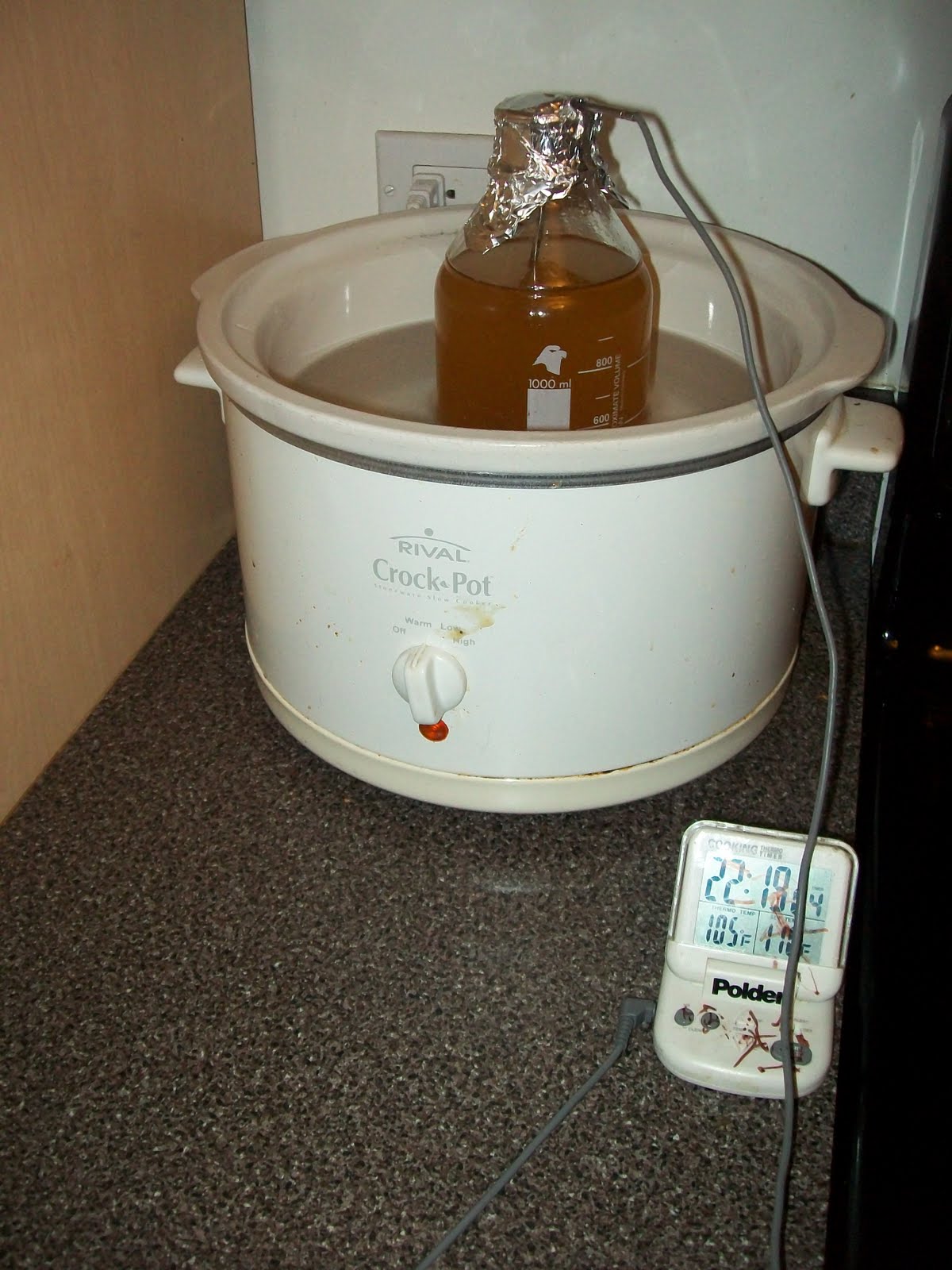
This brings me to unintended variable #3. The last time I made my lacto starter, I would occasionally dip it on a hot water bath to keep it over 90°F. This time around I discovered that my crock pot, set to "warm," kept it at a consistent 105°F. Also, last time I made my lacto starter, I only made 500mL; this time I made 1000mL. And to top it all off, I can't find my pH meter so I don't know what the actual pH of my starter was (though I have a sample in the fridge so I can find out when my new meter that I just ordered arrives). So I pitched a bigger--and likely more acidic--lacto starter this time around.

Once I pitched the lacto, I immersed the carboy in a hot water bath in a cooler as pictured to the right. I had an aquarium heater in there that would make sure the bath temperature never dropped below 90°F, and I covered the whole thing with a couple blankets. I also used a bucket heater two to three times a day to bring the temperature back up to 110°F, so most of the time the actual temperature of the wort was somewhere between 95°F and 105°F.

After roughly 45 hours, I took the carboy out of the hot water bath and siphoned the wort back into our brew kettle. I can't remember if this happened the last time, but this time around I found a white film on top of the carboy (as you can see below). I also noticed that there was a sickly sweet and vegetal smell, sort of like cream of tomato soup, which I distinctly remember from the last time I brewed so that didn't worry me. Since I had done a 15-minute boil on the first day I finished off with a 75-minute boil to make sure to drive off any DMS (which I believe is the source of the vegetal smell). I also found a little scum floating on top of the beer when the boil started (not sure if it was the film from the bacteria or protein due to the thin grain bed) so I skimmed that off.

I added hops at 60 minutes, Irish moss at 15 minutes and the freshly-ground coriander (1/2 oz.) and sea salt (5 g.) at 2 minutes. I chilled to 65°F and found the gravity to be 1047 (my target exactly). I oxygenated and pitched a 1/2 gallon starter of WLP320 yeast that should bring my original gravity down to 1046. This morning when I woke up the beer was fermenting away.

I kept samples of the lacto starter, the pre-boil wort and the post-boil, chilled wort, so hopefully I'll get pH readings of each of those so I have a better idea of how this beer compares to the last. All I can tell you for now is that I tried the post-boil sample and if my memory serves me correctly it had a distinct tartness I didn't pick up from the last Gose pre-fermentation. Will this indeed be more sour? I suppose I'll know in a couple weeks!

Monday, August 29, 2011

Reflections on a Gose: a tragedy in two parts

So, in my last post, I alluded to my Gose going bad. Well, I'm giving it another shot this weekend but in the meantime I wanted to tell my sad story...

Now, the first thing that went wrong was manageable: it was way more sour than I intended. The last time I brewed a Gose with lacto I let it inoculate for roughly 40 hours, and it dropped down to around 3.9. This time I let it inoculate for five days. The result? A pH of 3.2, which might not sound that different but, considering that pH is logarithmic, is. It's the difference between refreshingly tart (think lemonade) and downright sour (like an Oud Bruin). Not only did I feel this was more sour than I wanted, but it also raised the concern that the yeast may not be able to survive.

Well, it turned out the yeast was indeed able to ferment the acidic wort, though it still tasted more sour than I want. The good news was I had five gallons of Hefeweizen as well and could blend to the appropriate level of sourness. EXCEPT...

...while the Gose was in secondary I never changed from crimped foil to an airlock and somehow the foil cap blew off of my carboy while in my chest freezer. The result two days later was a white powder on the top of the Gose and a stench that could best be described as nail polish cleaner. Yup, had to dump all five gallons. It was a sad day, to say the least.

Now the good news is now I have an idea of the range of pH I'm dealing with. 40 hours? pH around 4, not bad but not exactly where I want it. 110 hours? pH around 3.2, which is too sour. So this time I'm thinking of shooting for around 75 hours with a pH of 3.45 (if my use of semi-log paper is accurate, which is a big if).

The other thing I'm doing is switching up my grain bill yet again. In this case, I'm planning on doing a split batch with my Münster Alt, which usually calls for 50% pils, 40% wheat and 10% Munich grain bill. However, Gose should be at least 50% wheat and, well, it's hard to find accurate info on Münster Alt so I decided to go with a compromise grain bill of 50% wheat, 40% pils and 10% Munich. So anyway, that's the plan for this weekend. Can't wait to see how this Gose turns out (and this time I'll be using a stopper and fermentation lock!).

Sunday, September 04, 2011

Brew day: F3 Münster Altbier and Gust Front Leipzig-style Wheat

Before lagers dominated the German brewing landscape, everything was ale. Over time, most of these German ale styles disappeared as people gravitated towards Pilsner, Helles, Doppelbock and the like. However, ales survived in a couple areas: the south (especially Bavaria) and the north Rhine valley. In the south, the ale of choice is Weizenbier (a/k/a Weissbier), which with its high percentage of wheat malt and its distinct tangy yeast is easily distinguished from lager. In the Rhine valley, however, the ale beer that survived is best described as a hybrid: it's fermented at ale temperatures with a rather clean top-fermenting yeast and then cold-conditioned like a lager. Since these hybrid beers still use the "old" method of ale brewing, they're generally referred to as Altbier (literally "old beer").

Two styles of Altbier are prominent today: Düsseldorf Altbier (Uerige, Metropolitan Iron Works) and North German Altbier (Kutcher Alt, Alaskan Amber). There are plenty of resources out there for folks who want to brew either of these styles. But there are other regional Altbiers that are either dying or extinct (you can read about some of them here). The only other Altbier I've come across in the U.S. is Münster Alt--Pinkus Müller can be found in Chicago at Binny's--so I figured I'd brew one for this year's all-Altbier Novemberfest.

Now, while there's plenty of info on Düsseldorf and North German Alts, there's virtually nothing on Münster Alts. Hell, I've found far more information on Gose than I have Münster Alt. But there are a couple recipes floating around that suggest 50% Pilsner, 40% wheat and 10% Munich. It should also be lightly hopped, somewhere between 15 and 25 IBU's. The biggest key, though, is that it needs to have a slight lactic tang.

As I noted in my last blog post, I brewed a Leipziger Gose a few months ago but due to a combination of neglect and bad luck it got infected and I had to dump it. I wanted to brew another one ASAP, so I decided I could do a split batch with the Münster Alt. The Gose should be at least 50% wheat, so as a compromise I elected to go with 50% wheat, 40% Pils and 10% Munich for my grain bill for both beers. As for the lactic tang, I'll have two options: I can add food-grade lactic acid to taste, or I could blend in a little of the soured Gose. I'm still not sure which I'll go with.

Before I recap the brew day, I should note that I had a couple new toys to play with today. The first is my new Blichmann burner. I initially bristled at the high price tag, but several folks assured me it's worth the money. We'll see how much more efficient it is than my old jet burner, but I can tell you it's definitely more quiet, plus I like that it's low to the ground (less chance of my idiot dog setting his tail on fire--again). I also decided to split my hose that runs from the mash tun to my kettle so that there's a second line that I can runs to a pitcher (as you can see to the left). That way, when I'm done recirculating (or when I want the check the flow rate) I can throw a couple valves and switch from filling the kettle to filling a pitcher or vice versa. It's rather simple, but makes things WAY easier for me.

For the brew day, I went with a 20-minute rest at 125°F (I like to do this with wheat or rye) and then a 45-minute sacc rest at 151°F. I collected for about an hour and a half, brought to a boil for 20 minutes, and then collected 6 gallons at ~100°F for my Gose. I pitched lactobacillus into the carboy and it's currently sitting in a water bath which stays between 100°F and 115°F.

The remainder of the kettle was hopped and boiled for another hour. I went with two additions: Warrior hops at 60 minutes and Saaz at knockout. Then I chilled and racked onto the yeast cake from our Schwarze Alt (which is done fermenting--it dropped all the way to 1.011!). As seems to be a pattern, my gravity was high (1.057 instead of the target 1.050) but my volume was low (4.75 gallons instead of 5.25). I used a half gallon to make a yeast starter for my Gose, so I added a half gallon of water to the remaining 4.25 gallons to drop the gravity down to 1.051. It's currently fermenting away in the basement chest freezer at 60°F.

I'm really curious to see how this turns out. I'll also need to decide how I want to do the lactic thing. Adding food-grade lactic acid would be easiest and most repeatable (unless I want to brew a Gose every time I brew a Münster Alt) but at the same time, if I already have a soured wort, why not take advantage of it? Stay tuned to see what I decide.

Saturday, September 05, 2009

Brew day (1 of 2): Gust Front Leipzig-Style Wheat

So, after all of my Gose talk, I finally got off my fanny and put my research into action today. Our Gust Front Leipzig-Style Wheat (technically a Leipziger Gose should be from Leipzig, hence my designation "Leipzig-Style") is actually going to take two different brew days, so this is just recapping the first leg of the journey to Gose.

In preparation for today, I made a 500mL lactobacillus starter on Thursday. I pitched around 115°F and kept it wrapped up to try and keep the temperature somewhat steady. Whenever it dropped to 80°F or so we would immerse it in hot water to raise the temperature back to around 110°F. We probably ended up doing this two or three times a day.

This morning, I brewed up six gallons of a 50% barley-50% wheat wort. I mashed in at 152°F at 9:50am, adding 1/4 tsp. acid blend to the mash. After an hour I decocted one gallon for fifteen minutes, bringing my mash-out temperature to around 164°F. I recirculated for ten minutes and sparged from 11:20 to 12:20, collecting six gallons. I boiled the wort for ten minutes to kill any nasties and chilled to 110°F. My temperature-corrected gravity at that point was 1046 and my pH was 5.5.

At that point I pitched my lacto starter. I took a pH reading and found my starter was down to 3.8, which yielded a noticeably tart taste (along the lines of lemonade) but nothing as extreme as a Berliner Weisse. Initially I was shooting for a pH of around 3.6 because the brewer at Bayerischer Bahnhof said the final acidity of the Gose should be 3.2-3.6. I thought it was odd that another professional German brewer said he shot for a pH of 4.0 before boiling when brewing a Berliner Weisse, which is more sour than a Gose. However, it occurred to me that pH actually drops during fermentation so maybe I should shoot closer to 4.0. Of course, given my inability to keep my temperatures up (right now I literally have my carboy under about four blankets; that's my means of temperature control) I'm not too concerned about the beer being too sour.

Anyway, the more I read about pH and brewing, the more I come across all sorts of potential issues I can't control and/or don't understand (let's just say water chemistry isn't my strong suit). For now, I'll just wait to see what happens. Barring something totally unexpected, I'll bring the soured wort back down to the garage on Monday morning, bring it to a boil, and add the hops, coriander and salt. Then I'll pitch onto the yeast cake from my Altbier (fermented with WLP 320 American Hefe yeast). Look for a wrap-up of the rest of the process Monday evening.

UPDATE: Just under 24 hours later, it's still at 96°F. Good to see those blankets are doing a pretty good job of insulating!

UPDATE 2: At roughly a day and a half, the wort is at 91°F. I took a sample and immediately noticed the wort is starting to smell funky. The wort has dropped to 3.95 and has a tang to it but is not what I would describe as particularly sour. That being said, it's already down to the pH that Christoph Bhenke recommended and, given how much the pH typically drops during fermentation I would assume we'll definitely get into the 3.2-3.6 pH range recommended by the brewer at Bayerischer Bahnhof. It'll be interesting to see how much further it drops by tomorrow.

UPDATE 3: For a recap of the second brew day, click here.

Monday, April 19, 2010

Final analysis: Gust Front Leipzig-Style Wheat

So this is long overdue, but I finally got around to doing a formal tasting of our Gust Front Leipzig-style wheat (a.k.a. Leipziger Gose). It's a good thing, because as you can see in the picture below, it ran out halfway through the pour! This beer took second place in the specialty beer category of the BOSS Chicago Cup competition, so I guess it's not too bad, but I still may tweak it in the future. Here's the review:


Style: Gose. Orig. gravity: 1050. Final gravity: 1014.
ABV: 4.8%. IBU's: 15.

Appearance: Pours a cloudy, deep straw color with a hint of orange. A nice white head tops the beer.

Smell: You pick up the tart smell of the lactic acid along with some green apple. There's a touch of yeast but not much.

Taste: The sourness hits you up front. It's definitely there but not overwhelmingly so; it's also a very clean sourness. As the tartness settles down, you get a nice combination of yeast and bready wheat maltiness. It's never savory but you do get a mineral bite in the finish. Very refreshing.

Mouthfeel: Nice body--not too heavy; not too thin--and adequate carbonation, though not quite as effervescent as a Hefeweizen.

Overall: As I noted a while back (towards the end of this post), I did a side-by-side of this with Döllnitzer Ritterguts Gose (my favorite Gose from Leipzig) and the biggest difference was mine was still significantly less sour than theirs. Now, Leipzig actually has two different breweries making Gose, and mine was in between the two when it comes to sourness. I still like the Döllnitzer best and I may try to make this more sour the next time I brew, but this one was definitely more accessible such that beer newbies still enjoyed it (something that probably wouldn't be the case with Döllnitzer). The other thing I'd like is to get more of a yeast bite from the beer; not sure how I'd do that but maybe I can mess around with different yeasts. But for my first time experimenting with lactic fermentation, I would consider this a resounding success.

Monday, July 04, 2011

Brew day: Step Leader Hefeweizen and Gust Front Leipzig-Style Wheat

While Leah liked it, I wasn't terribly happy with our last Leipzig-style wheat (a/k/a Leipziger Gose). For some reason it came out drier than last time, and though I kept the temperature hotter during the lacto phase it didn't come out any more sour. It also had terrible head retention.

This time around, I wanted to get it a little maltier, and one obvious option was a decoction. That's when it occurred to me that I could do a split batch with a Hefeweizen, taking half at the beginning of the boil to sour with lactobacillus and then boiling the remaining half and pitching a Hefeweizen yeast. With that in mind, I decided to go with my latest Hefeweizen grain bill (65% wheat, 30% Pilsner and 5% dark Munich) instead of the 50% wheat/50% Pilsner bill I've used for previous Goses.

Since I had the day off of work today (thank you, Founding Fathers) I figured I could brew today, incubate the Gose with the lacto, and give it five full days to sour before finishing it on Saturday. It also gave me plenty of time to brew what was one of my most complicated mash schedules to date (though, with friends coming and going throughout the day, it didn't seem that long... at least not until cleanup time!).

Using a schedule from Eric Warner's German Wheat Beer book, I did a double decoction. (To the right, you can see Jonas and I debating whether to do a single or double decoction; he was concerned about sufficient Maillard reactions.) I started with an acid rest at 108°F (supposed to be 99°F; not sure how I overshot it so badly) (while many think acid rests are unnecessary with modern malts, it is supposed to create ferulic acid which produces the clove esters during fermentation). After a 20-minute rest I did an infusion with boiling water to raise it to 147°F. After a 40-minute rest, I pulled a 9-qt. decoction. I held the decoction at between 158 and 162°F for fifteen minutes and then brought it to a boil for a half hour.

When I returned the decoction to the boil it only came up to 153°F instead of the 160 I was shooting for. I added 6 qts. of sparge water to get it up to 156°F and let it rest for fifteen minutes. I then pulled a 16-qt. decoction which I boiled for fifteen minutes before returning it to the mash for a mash-out of 167°F.

After recirculating for ten minutes, I sparged for an hour (quicker than usual; guess I wasn't paying close attention) and collected 12.5 gallons. I boiled for ten minutes and then began to collect six gallons at 110°F for the Gose. It was at 1.044, which should end up around 1053 after the boil.

For the remaining 6.5 gallons, I added bittering hops and boiled for another 75 minutes. Like last week, I had an unusual boil-off rate so I ended up with 4.6 gallons at 1059 instead of 5.25 at 1050. I decided to top it off with .75 gallons of bottled spring water to dilute it to 1051. I chilled to around 68°F and racked on top of a yeast cake from the Dampfbier I brewed last week and racked last night.

So now we have a little over 5.25 gallons of Hefeweizen in the chest freezer and 6 gallons of Gose in a cooler in a 110°F bath. Our basement is going to be the place to be in about three weeks!

Thursday, November 22, 2012

Brew day: Cloud-to-Cloud Dunkelweizen and Cousin Larry's "Wheat" Dark Wheat Ale

They say necessity is the mother of invention, and right now I need two things: beer to drink (preferably a darker style) and beer to potentially blend with our Christmas Gose which is both more sour than anticipated and somewhat underattenuated (likely due to the low pH being less than ideal for yeast). We realized we could kill two birds with one stone by brewing a Dunkelweizen. However, I don't want my Christmas Gose to have a strong Weizen taste (i.e. overwhelming banana and/or clove flavors) so I didn't want to use a Hefeweizen yeast for all ten gallons. In the meantime, I recently picked up some WLP 002 English Ale yeast so I figured if I used that for the five gallons to blend with the Gose I should get a fairly clean (though somewhat fruity) beer while at the same time making a starter for my next planned beer (a stout). Whatever I have left after blending I might dry hop with some British hops to create sort of a Weizenbock/mild ale hybrid. And thus Cousin Larry's "Wheat" was born (extra credit to those of you who get the reference, and I don't just mean the fact that Cousin Larry was a character in "Perfect Strangers").

A quick note on the recipe... I started out with a 60-40 wheat-to-Munich-malt ratio. Then I took a bit of a "clean out the cupboard" approach to the specialty malts, going with equal parts Caramunich III and pale chocolate malt because I had them on hand, and a touch of chocolate wheat malt. I also have been having issues with high final gravities lately and thus decided to go with a relatively low (by German standards) saccharification rest of 147°F to see if it would still taste malty but leave a drier finish.

Now on to the brew day... With time being a bit of an issue, I decided to skip my usual decoction schedule and instead go with a 15-minute ferulic acid rest at 108°F, the 147°F sacc rest for 40 minutes, and a mash-out at 165, using a combination of infusions and direct heat to reach each level. I boiled for 75 minutes with only one hop addition at the beginning of the boil. I was able to quickly chill the wort to around 62°F and pitched the English ale yeast into the 6.5-gallon carboy and my 850-mL starter of  WLP Hefeweizen IV yeast into the two 3-gallon carboys. (I should add that I forgot my O2 canister was empty so I had to oxygenate through the old-fashioned shake method.) My original gravity came in at 1052.

On a side note, the last time I checked my Gose it was still over 1030, though as sour as it is the sweetness actually helped to keep it balanced. Stay tuned to learn the results of my blending experiment.


Thursday, December 23, 2010

Revisiting Gose


What the heck is that, you ask? Why, it's a lactobacillus starter. Allow me to explain...

A little over a year ago Leah and I brewed our first all-grain Leipziger Gose. A Gose is a soured wheat beer brewed with salt and coriander. To get an authentic sour quality we use lactobacillus. Lactobacillus is most active around 100°F, and it just so happens that our crock pot set on "warm" creates the perfect bath for keeping our lacto starter at 105°F. We made the starter last night and will complete the first of two brew days tomorrow. (Yeah, this beer requires two brew days: on the first day you mash, sparge, collect in a carboy and pitch the lactobacillus; after two days you then boil your soured wort, add the hops, salt and coriander, cool, and pitch like a regular beer.)

Thanks to the crock pot, keeping the starter warm for two days is a piece of cake. What will be more tricky is keeping the actual beer around 100°F for two days (sadly a 6.5 gallon carboy won't fit in our crock pot). The last time we brewed the Gose it was Labor Day weekend and the weather was nice and hot; we just wrapped the carboy in blankets and it never got below 85°F. This time, however, we're brewing on Christmas Eve in Chicago. So what shall I do?

Well, I picked up a couple new toys. The first is an aquarium heater which is supposed to keep over 30 gallons of water at 91°F. I'll be putting the carboy in a cube cooler filled with water that will--hopefully--be around 90°F thanks to the aquarium pump. I figure if I cool to 110°F and put it in a bath at 90°F it should be a pretty good environment for the lacto to do its thing. Of course, the aquarium pump will also give me flexibility to brew other warm-weather beers like saisons in the winter.

The second thing I got is a bucket water heater. I'm pretty excited about this for two reasons. First, it will allow me to heat up the water in the cooler above 90°F if I want to try to keep the beer closer to 100°F. However, the cooler thing is that I can use it to speed up the heating of my mash and sparge water. In the winter, it can take a while to get water heated--especially when brewing 10-gallon batches. Between this and my propane burner I'm hoping it can shave a half hour or so off of my brew day.

Now will these toys work as planned? If past experience is any indication, probably not. But I really hope so, as it's always fun to have a little more versatility when brewing (and I'd hate to drop over $50 on stuff that doesn't work). Stay tuned to find out how tomorrow's brew day goes.

Sunday, September 27, 2009

Quick Gose update

After three weeks (that damn WLP 320 ferments sloooooooowly) I went to rack the Gose today when I noticed a slight problem... mold. Yes, that's right. Mold. Fortunately, there were only a couple dime-size patches on top of the Kraeuzen (I apparently spilled something on the outside of the carboy when taking a gravity reading and the mold started on the outside and worked its way in because I didn't crimp the foil cap tightly). I racked to the keg leaving the top three inches of beer (and the mold) behind, and the sample I took for a gravity reading didn't seem to yield any off-flavors. To the contrary, it was pretty damn good. The last time I took a sample it was at 1025 and was way sweet (and sweet plus sour may work for lemonade but not for beer). By now it has dropped to 1014 and is noticeably sour. I'm not sure it's a sour as Döllnitzer, but it's definitely more sour than Bayerischer Bahnhof. That being said, it wasn't as earthy and yeasty as I'd like, but I'm assuming the yeastiness will come with the natural conditioning (I added 76 g table sugar). If it still doesn't have that mineral bite when it's done, I may actually add a little more salt to the keg; we'll see.

Now if you'll excuse me, I'm in a tornado warning so I'm going to go figure out what's going on.

EDIT: In my hurry to seek shelter from a tornado that never existed, I forgot to mention that the Gose is in the Quimby keg.

Friday, August 18, 2006

D'oh! Leipziger Gose almost gone

Got out the trusty beer gun and bottled a twelve-pack of our Gust Front Leipzig-Style Wheat (or, auf Deutsch, Leipziger Gose) for various upcoming competitions (four for the Sam Adams Long-Shot competition, three for the Cactus Challenge (down in Lubbock), two for the Schooner Homebrew Championship (up in Racine, WI), and three extra bottles in the unlikely event we're a winner in the Sam Adams competiton in which case they need the three bottles to do lab tests). Much to my dismay, after finishing the bottling I found the keg to be incredibly light. I guess it's not too surprising, as the Gose is a great summer beer and visitors have been drinking it up. Of course, with most of our upcoming brewing devoted to our Oktoberfest party, things may be a little lean for a while. Fortunately I have bottles of various microbrews and imports up the yin-yang, so I guess I'll finally start to work my way through those.

In other brewing-related news, I "transferred" our last bottle of Cocoa Puffs Stout from a 22-oz. bottle to a 12-oz. bottle for the Cactus Challenge's "Area 51" unusual ingredient competition. And, since I didn't think the Cocoa Puffs stood out enough, I boiled a little bit of the beer with a whole bunch of baking cocoa, making a thick goop, and threw some of that in the 12-oz. bottle before filling it up with the Cocoa Puffs Stout. I only wish I could try it myself to find out if it kicks ass or sucks ass. Oh well. I guess I'll find out when I get my score sheet.

Sunday, April 22, 2012

Brew day: Village Green Mild Ale/Desperate Dan Dark Mild Ale

As I've mentioned before, we have a kegerator in the basement with four taps; my general goal is to keep one light beer (by which I mean light-colored, obviously), one dark beer, and one wild card on tap at any given time. The fourth tap is reserved for a non-alcoholic selection. I'm usually pretty good about this, and while occasionally we might have one tap empty for a week or so, that's by far the exception rather than the rule.

Until last week.

As recently as three weeks ago we had our Helles Lager, our Doppelbock and our Gose on tap. When our Helles and Doppelbock kicked in short succession, I replaced the former with our Witbier but didn't have anything to replace the latter. Then we brought our Witbier to a small gathering where I thought, at most, a couple gallons would be consumed, and we ended up killing that keg. Plus, when rearranging the kegerator I noticed the Gose keg is feeling rather light. I do have 10 gallons of Altbier lagering, but one of those kegs is reserved for Beerfly Alleyfight and the other won't be ready for at least another week (preferably two).

Bottom line is I need beer, and fast. Last time I was in this situation I came up with our Village Green Mild Ale, a light mild (perhaps better categorized as an AK, an obscure sub-style of the classic British bitter). Leah loved it and has been bugging me to brew it again. But I need both a light beer and a dark beer. At the same time, I've also been itching to brew a dark mild. If only there was a way to do both...

That's when it hit me: I can do both! My light mild ale was just a traditional dark mild ale without the dark grains, and dark grains don't need to be mashed; they can be steeped. As such, since I have two brew kettles and two burners, I could simply split the wort after mashing and steep the dark grains in the kettle for the dark mild ale. And that's just what I did.

Since I have a couple 3-gallon carboys, I decided to shoot for a 6-gallon batch yielding three gallons of each beer. I did a simple infusion at 154°F (two degrees below my target) and collected 7.5 gallons over the course of about an hour. At that point I pumped half from my one kettle to the other. In my second kettle I steeped 2.5 oz. of chocolate malt and 2.5 oz. of dehusked Carafa III malt for about twenty minutes while I brought the first kettle to a boil.

Things were delayed a bit when I ran out of propane and had to run to Walgreen's (pretty much every time my buddy Mark comes over to help me brew, I have to make an emergency trip somewhere), but ultimately I boiled each for an hour, with one hop addition at 60 minutes and Irish moss added at 15 minutes. Also, I had a bit of a problem with the invert sugar Leah and I made the night before (the webpage that I used the last time I made the syrup no longer exists, and apparently the new recipe I found had some problems since I ended up with a mason jar full of a solid, sugary mass) so I just added regular ol' turbinado sugar (un-invert sugar?) at 15 minutes.

As usual, my original gravity was high but my volume was low; I started with ~2.6 gallons of 1049 wort for each batch but diluted each with 1.5 liters of water to get to roughly 3 gallons of 1040 beer (you can see the difference in color in the picture on the right).  I aerated each carboy and pitched one packet of S-04 dry yeast in each carboy. Both were fermenting away within eight hours.

The last thing for me to consider was the name of the new beer. The light mild was named "Village Green" after the most British thing I could think of: the Kinks' "The Village Green Preservation Society." For its dark counterpart, I wanted to stick with the same theme, so I turned to the second verse of the same song. And thus Desperate Dan Dark Mild Ale was born. Can't wait to try the two side-by-side and see the difference 5 oz. of dark malts can make!

Tuesday, September 01, 2009

It's almost go-time for the Gose

So I've decided to pull the trigger on brewing my own Gose (as evidenced by the picture of lactobacillus delbrueckii to the left). After much deliberation, I've decided to go with the procedure described by "Øl-sheik" on probrewer.com (who I believe is Christoph Bhenke, head brewer at Søgaards Bryghus in Denmark):

Grist load: half malted barley, half malted wheat, designed to give about 15 EBC in Color and 11,5 Plato

Mash Intensivly for up to 2 hours


Collect runs offs and keep them at about 50 C or 122 Fahrenheit, inoculate with homofermentive lactobacillus, keep at 50 C until PH droped to about 4-4,2. This might take up to 48 hours


Boil and add hops for only bittering to reach 10-14 IBU,

I would add the salt (sea salt) at knock out rather then during mashing, although it would be more authentic. How much? No idea!

I would as well boil coriander in water separatly and add it after fermentation, rather then during the boil, to be able to control the level of intensity better.


Ferment with a bavarian hefeweizen yeast or belgium wit that has a high attenuation at usual temperature, mature for 2 weeks. I imagine that the refrehsing quality will profit from higher Co2 level.


Now, I'll be tweaking a couple things and am still trying to figure out some logistics. First, the tweaking:
  • I'm not sure what "mash intensively" means but I'm thinking I'll just do a single decoction at mash-out, as is my usual procedure.
  • I'm going to do a quick 15-minute boil before pitching the lacto.
Now, the logistics... How the hell do I keep the lacto-inoculated wort around 90-95°F? My initial thought is to run it into an insulated cooler and just hope it stays fairly warm. Sure, it'll drop, but the weather's supposed to be in the 80s this weekend so hopefully it'll stay in the neighborhood. However, my bigger concern is sterilizing the insulated cooler. We're talking wort at 95°F--prime real estate for bacteria. Hopefully the lacto will beat the crap out of anything else that gets in there, but I don't want to risk it.

Other ideas I had were buying a brew belt (though that only raises the temp five to ten degrees F above ambient), buying some sort of heating element, or building some kind of hot box, but I doubt I can get any of those done by Saturday morning (when I plan on mashing/inoculating). So for now I'm thinking I'll just make a starter on Thursday and hope that it'll have enough of a head start that it sours fairly well in 48 hours, even if it drops from 95°F to 80°F during the inoculation period.

Anyway, the plan for now is starter Thursday, mash/sparge/inoculate Saturday, boil/chill/pitch Monday. Stay tuned for the exciting results.

Saturday, September 12, 2009

Housekeeping

Stuff that will likely be of no interest to anybody but Leah and I:

Given the increased brewing output lately, I have lots of kegs floating around so I figured I should get info on the record about what's in what.

The Oktoberfest I filtered last week is in the Frink keg. The other keg in the fridge (I forget which one offhand) is the unfiltered Oktoberfest.

The Altbier brewed with WLP320, which was kegged last week, is currently in the Lovejoy keg. As of today it's at 1014, which I would assume is its final gravity. The Altbier brewed with WLP036, which I kegged this morning, is in the Nahasapeemapetilon keg. Curiously, it's still at 1020 so I'm hoping the transfer, and the warming up to room temp, will help it finish out in a week or so. The Lovejoy Altbier keg will have to sit at 60°F for another week until the Gose is done fermenting. Never thought I'd run out of storage space, but the kegerator is full, the garage fridge can only fit two kegs when carbonating (since I need room for my large CO2 tank), and I can't drop the chest freezer down to lagering temps when I have a carboy of Gose in there, so I can't condition the Alt just yet. Oh well.

Saturday, January 12, 2013

A rolling loaf gathers no Kvass*

*My apologies for the title. That might be my most tortured one yet.

So I have a few brewing updates that I need to get around to posting, but in the meantime I figured I'd post about something a little different... Kvass. What exactly is kvass? Well, Wikipedia describes it as follows: "Kvass is made by the natural fermentation of bread, such as wheat, rye, or barley, and sometimes flavoured using fruit, berries, raisins, or birch sap collected in the early spring." It's native to many parts of Eastern Europe and Russia, and while it's not really beer, it's close enough that a handful of U.S. breweries have dabbled in the style.

R.I.P. Passtimes (19??-2012)

I had vaguely heard of kvass, but the few times I came across the beverage my interest wasn't exactly piqued... that is, until I heard my friend Jenny mention she was making kvass for Christmas. Since I was working on my Christmas Gose at the time, I offered to trade her my Gose for some kvass and she gladly accepted. I don't know much about the process of making it except that it has a very short fermentation time, but after meeting Jenny and some other troublemakers at Hopleaf to swap bottles, I figured I would post some tasting notes here.

The first kvass (pictured above) was an orange and fig kvass. As you can see it pours cloudy like a turbid Hefeweizen. The nose was sweet like honey, but also with a an almost-harsh yeasty bite that I often get from homebrews which were under-pitched. I found the taste upon my first sip surprising: it was light and refreshing, similar to a fruit-flavored soda. It was not as sweet as a typical soft drink, but it also lacked the acidic bite, so it felt just as flavorful without being syrupy or overpowering. As for the flavor, I got a hint of bready sweetness, with a touch of rye spiciness, but the dominant flavor was sweet honey. There wasn't any tartness from the orange, so the soft, floral citrus notes of the orange melded with the brown sugar-like flavor of fig to taste like honey. The finish was well-balanced between tart and sweet and I did notice a rye flavor lingering in my mouth afterward. Overall it was very refreshing and something that definitely would make a nice alternative to a soft drink.

The second kvass was flavored with cranberry and sage. It was slightly more clear than the first kvass. Again, the nose reminded me of an under-pitched homebrew, though I didn't get the sweetness of the first kvass. The flavor was overall fairly similar though the honey flavor is much more subdued. It seems that the tartness of the cranberry doesn't come through the way the sweetness of the orange and fig did, though it's not necessarily a bad thing. Also, I didn't notice the sage up front, but together with the rye bread it gives a more pronounced herbal rye finish to the kvass.

I've definitely glad Leah and I got a chance to try these (thanks again, Jenny!). Overall, I found the kvass to be a very refreshing drink that could easily take the place of the overly-sweet soft drinks that are ubiquitous here in the States. Lately it seems that ethnic fermented beverages are starting to pop up more and more around Chicago (tepache and  kombucha come to mind) yet I've never had a chance to actually try any until now. And I have to say that kvass has definitely got me curious to try more of these concoctions. Though I should add one disclaimer: never try Hansa Malzbier. It's vile.